Viaggio Intorno Alla Mia Camera Ebook Readers
- Viaggio Intorno Alla Mia Camera Ebook Readers Free
- Viaggio Intorno Alla Mia Camera Ebook Readers Reviews
- Viaggio Intorno Alla Mia Camera Ebook Readers Pdf
Amos Farnitano is a brilliant street photographer with a keen eye for contemporary society, with a huge and solid background in this genre. By going though his exceptional photographic artwork, we will try and understand how street photography has changed over the years, what is a street photograph and what is the message behind it. By Luigi Coluccia Our today’s focus is on a very popular kind of photography which so many photographers all over the world love and practice. Street Photography is a genre that records everyday life in a public place. The very publicness of the setting enables the photographer to take candid pictures of strangers, often without their knowledge. Street photographers do not necessarily have a social purpose in mind, but they prefer to isolate and capture moments which might otherwise go unnoticed.
Viaggio intorno alla mia camera PDF Download. Free Online Rating News 2016/2017 is books that can provide inspiration, insight, knowledge to the reader. Viaggio intorno alla mia camera Spedizione notturna. Protagonisti degli spettacoli che si alterneranno nei giorni della manifestazione saranno dunque l'esodo, la patria, la ricerca della terra promessa e il viaggio, inteso in. In collaborazione con le istituzioni locali, con l'Area Marina Protetta e con la Cooperativa Solidalia ogni spettacolo – dal reading al concerto musicale,. EBook - GRATIS. Trova questo libro nella versione stampata. Viaggio intorno alla mia camera. Ed a cura di Anonymus AC10403448 Informazioni su questo libro.
Street Photography and Documentary Photography are sometimes overlapping, though they have very distinct qualities. While documentary photography aims at recording history, providing emotional intensity, Street photographs are mirror images of society, displaying un-manipulated scenes. They are also candid ad often produce ironic amusement. To better investigate this photographic genre, we have asked Amos Farnitano, a brilliant street photographer with a keen eye for contemporary society, to tell us about his huge experience. By going though his exceptional photographic artwork, we will try and understand how street photography has changed over the years, what is a street photograph and what is the message behind it. Amos, 56 years old, lives in Rome.
He loves motorbikes, especially for that feeling of freedom of action or thought which he has never turned down in his life. He is a keen observer of the world around him, which helps him a lot to grasp every candid aspect of the contemporary society.
Amos embodies all those values that are behind this photographic genre and his street photographs are mirror images of our, contemporary society and habits. He says: “ I am a witness of what I see on my way, I try to tell small stories, often trivial and insignificant. I think the world is made by ordinary people, coloring daily life with their gestures. I’m attracted by common scenes that remain unseen to many people, just because they are ordinary and irrelevant scenes. Images and stories that would never end up in newspapers, books or sociology pamphlets, but will remain forever in my memory and hopefully in the viewer’s memory. ” Common people then.
Faces, gestures, expressions, emotions. All inclusive in a single frame, that can tell the whole story, with the candidness of a man who always manages to get to the heart of every circumstance. With his clever eye and deep sensitivity, Amos is able to capture everyday life events, always rendering a candid and storytelling vision of what he sees, without any tricks and with a simplicity that makes each image a very original one. AVB: Amos, thank you for accepting our invitation to have this chat. Before focusing on Street Photography, let’s start from the beginning. Where does your passion for photography come from and how was the start?
AF: Thank you so much to you for this opportunity. Actually photography has always been part of my family. My mother worked in a photographic studio, my uncle was a great photographer in the latest ‘50s, during the period of the Dolce Vita in Rome. It has been so natural to me to approach photography.
I was given my first camera at 11. It was a Kodak Instamatic.
Since that moment fun has never ended, because to me, photography is especially fun. AVB: You have probably landed to Street Photography after having experienced several other photographic genres – correct me if I’ m wrong! – as it has happened to many of us. How did you come to street photography then? What was attracting your attention? AF: You are completely right, of course. I started taking some “souvenir” photographs, the typical ones you shot while traveling.
It’s only when you become aware of the high potential of photography that you start being more selective. I was born and raised in the suburbs of a big city like Rome, I grew up in the streets, where I played, where I found my friend and my loves. The rest came almost spontaneously. I think street photography is very peculiar, I would say a bit anarchic, where chaos is regulated by chaos and this reflects my way of being. Amos Farnitano AVB: You are part of the Admin Staff of a Facebook group that is an important international benchmark for the genre. You have been there for many years, taking up this role with dedication and passion. Your point of view is definitely a “privileged” one.
How has street photography changed over the years? Do you think your approach to street photography has changed over the years, maybe influenced by a general evolution of the genre or did you stick to your values? AF: It is a very exciting but hard task, having to manage a group with 160,000 members. “Street Photography in the world” is the brainchild of my friend Roberta Pastore, who got me involved since the beginning. We are very proud of it, indeed. Early March we released our first eBook, “, which is on sale on Blurb.com.
It is a wonderful publication in which we collected 38 photographers participating in the group and their photographs, to give them visibility and a chance to become popular to a larger audience. It has been a nice experience. Coming back to street photography and its evolution, it actually is an atypical genre, as I said before. As in many things in life, you can have different visions.
It is constantly changing and evolving. Even though it sometimes loses that peculiar vision rendered from the “street”, I believe that it is good to test, experiment other points of view, as long as you stick to your, own, personal expression. The greatest risk is emulation: the same captured scenes resulting in photographs which are all the same and more oriented to stylistic perfection rather than communication. AVB: That’s something really peculiar in most of your photographs. If we have a closer look to your artwork, we can suddenly realize the peculiar framing. When the subject comes closer to you in fact, the POV appears to be on a lower level than the usual one. Why is it so?
How can you shoot in this way? I know the answer already, but I think that our readers can find it very interesting. AF: It basically comes from the fact, I do not want to interfere with the scene. I do not look into the camera to shoot, but I shoot by holding it in my hands at a lower level. With a bit of experience you can eventually find the right framing, the one you are looking for. Using fixed 28-50 lenses makes the rest. You can get closer, being involved in the scene, even though you remain “invisible” for the subjects.

This is my, personal technique. However it is not a dogma. Amos Farnitano AVB: As it often happens, photographs reflect a bit the photographer’s personality and temperament.
Your photography is never trivial. While shooting, you always develop a theme. It is not about single images, but series of photographs linked by the same “fil rouge”, each of them belonging to a specific story. Is it simply for searching purpose, rather than a real, inspirational, creative path, which starts anywhere and ends anywhere else? In this case, how does it start and when does it end? AF: It’s all based upon the places, the people and the situations I see around me. My state of mind also plays a role.
I always know where to start with an inspirational path. It is more difficult to me to see the end. I think, I am a storyteller, I tell short stories through images. They randomly come to my eyes, while walking in the streets and watching what’s around.
There’s nothing programmed in my job. In short, I never walk out to shoot, I just go out for a walk and let myself be inspired by things I see around me. Amos Farnitano AVB: It’s hard to go through all our creative inspirations, they are so many and so many are your works. Among them, I think that Japan can actually represent one of you most successful creative inspiration. I would say, Japan and Japanese are your trade mark in street photography. Why do you love Japan, Japanese people and their culture?
What has Japan added to your experience as a street photographer and what did you give back to this beautiful land? AF: It has been by chance, I fell in love with Japan and Japanese the first time I went there for a trip.
Then, I went to Japan several times and each time was different. I’m not used to travel to visit monuments, I like visiting countries to get closer to people, their daily life, culture and habits. In japan I found chaos, which I love so much.

I live in a big, chaotic city, where chaos and confusion are limiting and badly affecting your daily life. It is different in Japan. The Japanese chaotic way of living is in some way relaxing to me. I love their contemporary, modern way of life, they seem to live in a cartoon, their lives are like cartoon strips to my eyes. Last but not least, Japanese women are so beautiful. Japan has given so much to me in terms of growth and inspiration.
I hope my photographs can effectively tell how amazing those people are.
In 1790, while serving in the Piedmontese army, the French aristocrat Xavier de Maistre (1763-1852) was sentenced to house arrest for forty-two days, for dueling. The result was a discursive, mischievous memoir, his classic Voyage Around My Room. De Maistre's literary output began with his Voyage (1794) and ended with its sequel, Nocturnal Expedition Around My Room (1825), In 1790, while serving in the Piedmontese army, the French aristocrat Xavier de Maistre (1763-1852) was sentenced to house arrest for forty-two days, for dueling. The result was a discursive, mischievous memoir, his classic Voyage Around My Room. De Maistre's literary output began with his Voyage (1794) and ended with its sequel, Nocturnal Expedition Around My Room (1825), with a few shorter pieces in between. In addition to the Voyage and Expedition, this Selected Works includes the compelling dialogue 'The Leper of the City of Aosta' (1811) and a 'Preface' by Xavier's better-known older brother, the reactionary Joseph de Maistre. A digressive, funny, philosophical late-18th-century work told by a man confined to his room: though he interacts occasionally with his manservant and his dog, one could argue that the narrator’s Soul (an entity he refers to as ‘she’) and Animal natures are the biggest presences in the room.
The debt to ’s is obvious, even without the narrator’s mention of Uncle Toby. Added on 1/24/17 after meeting with my friend for our little b A digressive, funny, philosophical late-18th-century work told by a man confined to his room: though he interacts occasionally with his manservant and his dog, one could argue that the narrator’s Soul (an entity he refers to as ‘she’) and Animal natures are the biggest presences in the room. The debt to ’s is obvious, even without the narrator’s mention of Uncle Toby. Added on 1/24/17 after meeting with my friend for our little book 'club' of two: She made the point that it's likely that Soul is female because all French nouns have a gender. 'Voyage Around My Room' is the perfect book to read when in bed with a cold. In another life, I would like to list my favorite books to read in bed while sick. This would be in the top ten for sure.
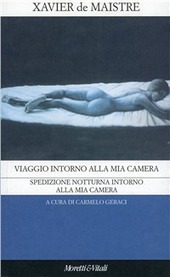
The author, Xavier de Maistre, was busted for dueling and sentenced to house arrest for 42 days. What came out of that self-imprisonment is this book.
It borders on a Georges Perec or Alain Robbe-Grillet type of fiction, but it was written in 1790. Xavier comments on the paintings and furniture in hi 'Voyage Around My Room' is the perfect book to read when in bed with a cold. In another life, I would like to list my favorite books to read in bed while sick. This would be in the top ten for sure. The author, Xavier de Maistre, was busted for dueling and sentenced to house arrest for 42 days. What came out of that self-imprisonment is this book.
It borders on a Georges Perec or Alain Robbe-Grillet type of fiction, but it was written in 1790. Xavier comments on the paintings and furniture in his room. In essence, time has stopped. It can even be a critique of at then modern living. The sensibility behind this book is timeless.
It's work from the past but seems very present. The author reflects on his life through his landscape, which is the room. I would recommend writers to read this book, in the same sense one can read Raymond Queneau's 'Exercises in Writing' or Joe Brainard's 'I Remember.' It reminds me that one is never truly shut off from the world when they have pen and paper. Not more than a moment ago I experienced paroxysms of fear: I could not recall the whereabouts of this book. It's a pet theory of mine that no matter how much you read, you will only be able to truly know a handful of works in one lifetime.
Viaggio Intorno Alla Mia Camera Ebook Readers Free
Voyage is such a work in my life. For anyone with anchorite tendencies this is a magnum opus and will touch you to the quick.
The narrative is anything but to the point - but that's the point! Without digression life is flavorless and, 'Why should the soul Not more than a moment ago I experienced paroxysms of fear: I could not recall the whereabouts of this book. It's a pet theory of mine that no matter how much you read, you will only be able to truly know a handful of works in one lifetime. Voyage is such a work in my life.
For anyone with anchorite tendencies this is a magnum opus and will touch you to the quick. The narrative is anything but to the point - but that's the point! Without digression life is flavorless and, 'Why should the soul refuse any of the delights scattered along the difficult path of life?' Fans of Rabelais, Cervantes, Jonathan Swift, Laurence Sterne, and Thomas de Quincy will wonder how this enchanting book remains largely overlooked today. Like these elastic authors, de Maistre lacks no breadth of reason, passion, or humor even when discoursing on seemingly trivial matters. De Maistre is a minister of minutiae, and this is his manifesto.
Necessary reading for all serious sedentary voyagers. I was introduced to this book through reading de Botton's Art of travel, de Botton has also written the foreword so it links well. This is such a random book I was astonished to find it in a normal bookshop, but I did, and the rest is history.
The reason why this book is so good is due to the importance of the central idea, this idea is self evident from the title. To stretch out a narrative journey from his bed to the window and the view outside is quite an achievement, especially as this journe I was introduced to this book through reading de Botton's Art of travel, de Botton has also written the foreword so it links well. This is such a random book I was astonished to find it in a normal bookshop, but I did, and the rest is history. The reason why this book is so good is due to the importance of the central idea, this idea is self evident from the title. To stretch out a narrative journey from his bed to the window and the view outside is quite an achievement, especially as this journey is entertaining and interesting in equal measure. This proves the most important aspect of travel literature, it doesn't matter where you go, it's what you do, how you do it and what you learn from it. If you apply the spirit of adventure to a trip to the supermarket it can be more important than a round the world trip.
My only problem with the book were elements of context, it was written quite some time ago so I found some of the references unfamiliar. If you enjoy this book try to get hold of some of the other Hesperus Classics they specialize in publishing overlooked gems. He managed to create such a weird stuff with such a few words. And that's an accomplishment. The story did give me a positive thought-that you can turn a prison into a heaven by changing your perception of it.
But I don't think he would have written all these things about that room had he resided in it for too long a time. And the thing about mirror. That was real good. To see oneself and soul and the other.
I do not how the materialists would respond to that but since I am Why five.? He managed to create such a weird stuff with such a few words.
And that's an accomplishment. The story did give me a positive thought-that you can turn a prison into a heaven by changing your perception of it. But I don't think he would have written all these things about that room had he resided in it for too long a time. And the thing about mirror. That was real good. To see oneself and soul and the other. I do not how the materialists would respond to that but since I am not one,I can say that it was brilliant.
It seems I have written this review different from the way I usually write. But that's how I really feel.!! I just browsed the ratings other readers gave to this book and saw mixed ratings and reviews,like it is for almost every book(except those which everybody wholeheartedly put under trash).
I am going to re-read this book. I really want to see if I missed something. May be an apple will fall on my head during the next read. Long before Georges Perec and company, an imprisoned French official wrote a treatise describing his room as the world, and his adventures therein. It's the sort of thing I would doubtless think up if I was under house arrest.
But what I particularly loved about it was that it was the sort of thing that Calvino or Robbe-Grillet or Eco would have thought up, the Savoyard militarist entering worlds of the imagination through mundane objects, and perhaps using that as a metaphor for some theme or t Long before Georges Perec and company, an imprisoned French official wrote a treatise describing his room as the world, and his adventures therein. It's the sort of thing I would doubtless think up if I was under house arrest. But what I particularly loved about it was that it was the sort of thing that Calvino or Robbe-Grillet or Eco would have thought up, the Savoyard militarist entering worlds of the imagination through mundane objects, and perhaps using that as a metaphor for some theme or turning point in the history of ideas, and I would have enjoyed it, heaps. But the fact that it's the genuine article. Curiosity level: very very entertaining! Wish it was longer! 'Was it this to punish me that they confined me to my room?
One might as well exile a mouse to a granary.' -p.78 Xavier de Maistre, having found guilty of duelling, is confined to his room for 42 days. While most of us might start chewing off our nails (w/o WiFi), he dreams up worlds. The bed, the mirror, the desk - all come alive in animation. Breathing out stories. Xavier essentially wants to tell the reader this: You don't need your Curiosity level: very very entertaining!
Viaggio Intorno Alla Mia Camera Ebook Readers Reviews
Wish it was longer! 'Was it this to punish me that they confined me to my room?
One might as well exile a mouse to a granary.' -p.78 Xavier de Maistre, having found guilty of duelling, is confined to his room for 42 days. While most of us might start chewing off our nails (w/o WiFi), he dreams up worlds.
The bed, the mirror, the desk - all come alive in animation. Breathing out stories. Xavier essentially wants to tell the reader this: You don't need your passport, luggage or money for an adventure! You can organise a voyage around your room! Written in a deadpan yet enthusiastic humour-style, this book reminds me of a hilarious George Orwell and Umberto Eco combo:) 'They may have forbidden me to travel through a city, but they left me the entire universe: infinity and eternity are at my command.'
P.s he also wrote a part 2: nocturnal expeditions around my room. I didn't expect to like this book so maybe it was a self-fulfilling prophecy, or maybe I'm just out of touch with writing from other centuries, but I found the 18th- and 19th-century ruminations of this French count/soldier pompous and dull - though not without humor. He clearly fancied himself a great philosopher, with thoughts and revelations he was convinced were unique. The edition I read contained 'Voyage Around My Room' (1794), 'Nocturnal Expedition Around My Room' (1825), and 'The Leper I didn't expect to like this book so maybe it was a self-fulfilling prophecy, or maybe I'm just out of touch with writing from other centuries, but I found the 18th- and 19th-century ruminations of this French count/soldier pompous and dull - though not without humor. He clearly fancied himself a great philosopher, with thoughts and revelations he was convinced were unique.
Viaggio Intorno Alla Mia Camera Ebook Readers Pdf
The edition I read contained 'Voyage Around My Room' (1794), 'Nocturnal Expedition Around My Room' (1825), and 'The Leper of the City of Aosta' (1811). I actually quite enjoyed the leper story, which was the shortest of the bunch, but could have done without the 'voyages' in which the author imparts his self-proclaimed 'brilliant logic' and honors the reader by 'unveiling such truths to humanity.' This book fulfilled a requirement for the letter 'X' in an alphabet-based reading challenge. I probably would have abandoned it otherwise, though I'm glad I persevered and read the leper story.
I'll admit to skipping the short 'preface' by the author's brother that was included at the end. Komrij wijdt een hoofdstuk aan dit boek in zijn bundel. Er wonen twee reizigers in de reiziger: de een gaat heen, de ander terug. (.) En teruggekeerd van de reis, op zijn kamer, ondergaat hij die indrukken pas in werkelijkheid. Hij reist op zijn kamer.
Had hij niet beter meteen thuis kunnen blijven? (.) Voor reizen hoeft hij de straat niet op.
Hij kan thuis boeken over reizen lezen, en zelfs boeken over reizen thuis: een verdubbeling die tot de zevende hemel leidt. Laat Komrij wijdt een hoofdstuk aan dit boek in zijn bundel.
Er wonen twee reizigers in de reiziger: de een gaat heen, de ander terug. (.) En teruggekeerd van de reis, op zijn kamer, ondergaat hij die indrukken pas in werkelijkheid. Hij reist op zijn kamer. Had hij niet beter meteen thuis kunnen blijven? (.) Voor reizen hoeft hij de straat niet op. Hij kan thuis boeken over reizen lezen, en zelfs boeken over reizen thuis: een verdubbeling die tot de zevende hemel leidt.
Laat staan boeken lezen over boeken over reizen thuis! Ik vond Komrijs essay over Reis door mijn kamer prettiger leeskost dan de Reis zelf. (Laat staan een reis.).