Canadian Firearms Centre Police Officer Field Handbook
Flag of the Motto Fidelis ad Mortem Faithful till Death Agency overview Formed 1950 Legal personality Governmental: Jurisdictional structure Operations jurisdiction of in the of, Map of New York City Police Department Auxiliary Police's jurisdiction. Size 1,214.4 km² Population 8,274,527 Legal jurisdiction General nature. Civilian agency Operational structure Headquarters Auxiliary Police Section 120-55 Queens Boulevard Kew Gardens, NY 11424 Auxiliary Police Officers 4,500+ Police Commissioner responsible Agency executive Inspector Phylis Bryne, Commanding Officer Parent agency Units. List. Manhattan North. Manhattan South. Brooklyn North.
Brooklyn South. Queens North. Queens South. Bronx.
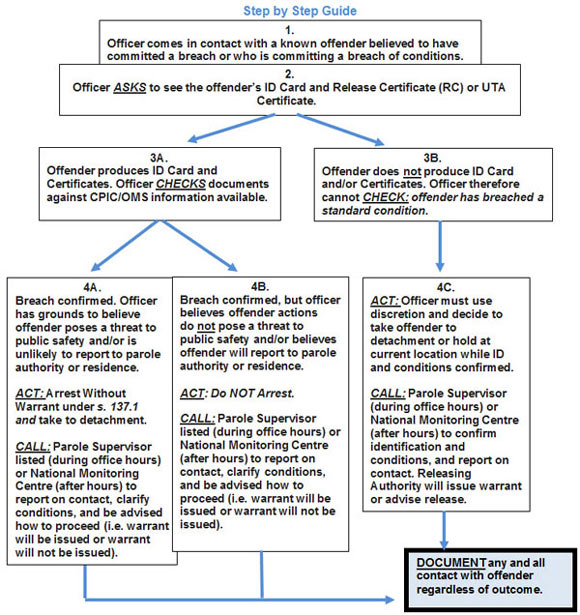
1.5.5 Members Issuing a Promise to Appear (Field Release Officers) - DELETED. Police Department as outlined in this Manual (see Section 1.7.1) and the British Columbia Disaster. During these incidents, the Vancouver Fire. By virtue of an entry for an arrest warrant on the Canadian Police. Forms & Applications A collection of all forms available for download. You will always find the latest copy here. Therefore, the law enforcement powers for arrest contained in s.495 Criminal Code of Canada do NOT apply. Your power of arrest for. The peace officer is asked to contact the offender's Parole Officer or the National Monitoring Centre to report contact with the offender. Additionally, police are asked to.
Staten Island Facilities Commands 76 Precincts 12 Transit Districts 9 Housing Police Service Areas Police car/vans 120 Police boats 2 Website Footnotes. Division of the country, over which the agency has usual operational jurisdiction. The New York City Police Department Auxiliary Police is a volunteer force which is a subdivision of the Patrol Services Bureau of the. Auxiliary Police Officers assist the NYPD with uniformed patrols, providing traffic control, crowd control, and other major events. Over 4,500 Auxiliary Police officers contribute over one million hours of service each year. The NYPD Auxiliary Police program is the largest Auxiliary Police program in the United States.
Dark Blue History The precursors to the Auxiliary Police were organized primarily during times of war when police officers were drafted into service, leaving the city with a diminished police force. The Home Defense League was established in New York City in 1916 under Police Commissioner to supplement the police force.
Many police officers had joined the armed forces as the in Europe progressed. Citizens volunteered to enroll in the Home Defense League to aid police in patrolling duties and be on hand in case of emergencies. In a matter of months, 22,000 people had volunteered for the Home Defense League. They were required to attend trainings on handling prisoners, protecting themselves, and using weapons. They received no pay. If the need arose (as it did in 1917 when armed forces were mobilized), they could be called into service to guard armories, subway stations, and other areas of the city. In 1918, the Home Defense League changed its name to the New York Reserve Police Force, as proposed by Commissioner, in addition to undergoing higher-caliber training under Special Deputy Police Commissioner.
Over 3,000 women joined the Police Reserve, serving under Captain Mary Noonan, primarily to provide eyes and ears for the police, look out for children's safety, and give first aid if necessary. Governor signed a new state law in 1920 that established the permanency of a reserve force as an adjunct of the police department. By the mid-1920s, however, the Police Reserve had gradually stopped functioning as an active part of the Police Department, due to political disputes in a high-crime period. Australian 1 note serial numbers. The Reserve was formally disbanded in 1934.
During, the need for a reserve force briefly returned. The City Patrol Corps was organized in 1942 to assist police in patrol work; over 4,500 men and women volunteered. By war's end in 1945, the corps was disbanded, but the city continued to maintain a volunteer police unit. In 1950, the passed the Public Law #920, entitled 'The Civil Defense Act of 1950,' authorizing a.
In 1951, the New York State Legislature enacted the 'Defense Emergency Act' requiring New York City to recruit, train, and equip volunteer Civil Defense wardens, who would provide traffic and crowd control and other assistance to police officers in the event of an emergency or natural disaster. The provided status for the Civil Defense wardens during the event of an actual natural or man-made disaster or attack or during training drills. In 1967, a Mayoral Executive Order closed the Civil Defense Headquarters and placed full responsibility of the Civil Defense wardens with the NYPD. The NYPD retitled the division Auxiliary Police, changed the uniform to reflect police officer uniforms, and revised the duties of Auxiliary Police.
During the 1960s when crime was on the rise, uniformed Auxiliary Police patrols were one means to deter crime. Training and Authority Auxiliary Police recruits must pass an 18-week, 140 hour 'Auxiliary Police Basic Training Course' which is classified as 'Peace Officer Training'. Auxiliary recruits are required by the New York State Municipal Police Training Council to undergo and pass this training course before they become Auxiliary Police officers. The training given in this course includes training in penal law, police science, discipline, powers of a peace officer, radio use, defensive tactics, unarmed self-defense, self-defense with a, physical training, chemical training, first aid, handcuffing techniques, and arrest procedures. In 2008, the NYPD revised the training course to include training in location and use of pressure points, dealing with domestic violence situations, firearm safety, and terrorism awareness.
A written and physical exam is given at the end of training. Upon the completion of the Basic Training Course, the physical exam, and the written exam, probationary Auxiliary Police officers are issued their shield and police identification card along with their baton and initial uniform allowance voucher.
Probationary Auxiliary Police officers must patrol with a field training officer. All Auxiliary Police officers are required by New York State to pass an annual refresher course in the use of force with the straight baton, arrest procedures, and law in order to maintain their status. Auxiliary Police officers are certified as 'Peace Officers without Firearms Training' by the New York State Division of Criminal Justice Services - Municipal Police Training Council, and are registered as peace officers in the NYS DCJS registry of peace officers. Although volunteers, Auxiliary Police officers are city employees while on duty and may be eligible for Workers' Compensation in the event of injury while on duty. Auxiliary Police officers must purchase and maintain equipment at their own expense. Officers who work the minimum required hours per fiscal year receive an annual uniform allowance check to help pay for new and replacement equipment and uniforms. A NYPD Auxiliary RMP.
Main article: Two weeks after the, a new directive stated that New York City would institute a citywide transit Auxiliary program with the intent of reducing crime and fighting terrorism in the city's transit system. Transit Auxiliary officers work out of Transit Bureau precincts known as Districts and carry Transit portable radios. Unlike a precinct, the transit districts cover miles of underground subway. Transit Auxiliary Police officers go through additional training by the Transit Bureau Vandals Squad as well as the Counter-Terrorism Division to build vandalism and terrorism awareness within the Transit System. Transit Auxiliary officers are paired with either a regular police officer or Auxiliary police officer.
Transit Auxiliary Police periodically perform inspections of the subway station(s) and platforms which they are assigned to, taking note of any suspicious occurrences, and set up a fixed post at the subway turnstiles, token booths, mezzanines, or platforms. Transit Auxiliary officers also conduct subway train inspections as well as train runs to/from stations that which assignment is given. Due to the common medical emergency calls in Transit, if medically qualified, Transit Auxiliary Police officers can respond to medical emergencies if they are near to the transit location. The main function of the NYPD Transit Auxiliary Police, like the NYPD Transit Police, is to primarily remain within the subway system. Specialized Auxiliary Police units : Officers patrol, parkways, and main thoroughfares throughout the City of New York.
Auxiliary Highway Patrol officers wear the same uniform as regular Highway Patrol officers and patrol in regular officers RMPs in Auxiliary Police Highway Patrol RMPs with AUXILIARY decals on each side. All applicants to this unit are required to have a minimum of five years experience as a patrol officer with the NYPD Auxiliary Police, must be mature, and have exceptional discipline and service records. Officers will be required to attend an Advanced Vehicle Operation Course before they may operate a Highway Patrol Vehicle. See article:: Officers patrol New York City's waterways. A marine background such as one obtained through the U.S. Coast Guard, military, or other marine background is required.
Citywide Traffic Task Force (CTTF): Officers patrol in areas all over the city that need special attention and extra patrol. However, more typical of this unit is performing duty during special events such as concerts, marathons, parades, etc. To increase the police presence. They are involved in both vehicular and pedestrian traffic control. They do not confine themselves to one location or precinct. Undercover Vice Ops: Officers that have not reached the age of 20 years and 6 months old can be utilized to assist the NYPD Vice Unit Narcotics Division for 'Quality of Life enforcement' stings which address illegal alcohol, knife, and spray paint sales. Other than this exception, NYPD Auxiliary Police officers are never undercover (.unless authorized by the Police Commissioner or Commanding Officer of the Auxiliary Police) and always patrol in uniform.
Officers who have received the necessary 'Vice Training' may be used by their command in surveillance operations. Ceremonial Unit: The Auxiliary Police also has a ceremonial unit made up of a small group of Auxiliary officers. Auxiliary Patrol and Police Vehicles. A Auxiliary RMP. Patrol is one of the most important duties Auxiliary officers can perform.
Various types of patrols are possible within different precincts. Almost all precincts perform foot patrol. Other types of patrol include:. RMP (Auxiliary Police Car) - cars are painted white with light blue decals. Van (15 passenger; Used for routine patrol and officer transport) - vans are painted white with light blue decals. Bicycle.
Police Golf Cart (only used in Manhattan's Central Park Precinct) In most cases, Auxiliary Police vehicles are retired vehicles that were once used by regular officers. Once the vehicle attains a certain amount of mileage, it is taken out of service and is either redecaled and given to a command for the Auxiliary Police, or is sold. Auxiliary Highway Patrol RMPs are retired RMPs previously used by regular officers. Most commands only have one Auxiliary vehicle, but some have 2 or more.
The number of Auxiliary vehicles per command is based on how many Auxiliary officers are working there and how many extra vehicles the NYPD has available. It should also be noted that older Auxiliary vehicles are painted either dark blue or black with white decals in contrast to the vehicles used by regular officers, which are white with light blue decals. In 2008, the NYPD changed the paint and decal color of Auxiliary vehicles to white with light blue decals in order to look like vehicles used by regular officers and as an economy measure to save money by not having to repaint the vehicles.
Officers wishing to operate a bicycle, RMP, or van need special training before they are allowed to operate them. Training is done by the Police Academy Driver Training Unit (PADT) which is located at in. The, which is special to the Central Park Precinct, also requires special training to operate. Auxiliary Police officers are not issued, and are not permitted to carry firearms while on duty, even if otherwise authorized/licensed to carry when off-duty.
Seven officers have been killed in the line of duty. Risks are involved, On March 14, 2007, two Auxiliary Police officers—Eugene Marshalik and Nicholas Pekearo—were killed in a shootout in. Up until March 26, 2007, the did not issue or subsidize to Auxiliary officers. But after the shootings of Pekearo and Marshalik, and asked the to earmark more than 3.3 million dollars to provide all Auxiliary Police officers with Level IIIA Vests, the same used by full-time officers. On March 27, 2007, the City Council approved this bill, which had all Auxiliary officers equipped with vests.
Since then, in 2010, funding for vest for Auxiliary Police Officers has run out of the NYPD City Budget. Every Police Precinct, Housing Police Service Area and Transit District has a pool of 'loaner' vest for new Auxiliary Police Officers to use while on patrol. Afterwards, they are returned and secured by the Auxiliary Coordinator. Representation New York City Auxiliary Police Officers of all ranks have been represented since 1965 by the Auxiliary Police Benevolent Association of the City of New York (APBA). While Auxiliary Police Officers are not full-time employees of the NYPD, they face many of the issues regular Police Officers face regarding working conditions, including safety, disciplinary actions, and uniform allowance reimbursement. Membership is voluntary. Line-of-duty deaths Since the establishment of the New York City Police Department Auxiliary Police, seven officers have died in the line of duty.
Officer's name End of watch Cause of death Auxiliary Sergeant David Freed Sunday, August 31, 1975 Assault Auxiliary Sergeant Noel R. Faide Sunday, January 29, 1989 Vehicular Assault Auxiliary Sergeant Larry L. Cohen Sunday, January 29, 1989 Vehicular Assault Auxiliary Police Officer Armando Rosario Wednesday, March 25, 1992 Gunfire Auxiliary Police Officer Milton S. Clarke Wednesday, December 1, 1993 Gunfire Auxiliary Police Officer Nicholas T. Pekearo Wednesday, March 14, 2007 Gunfire Auxiliary Police Officer Yevgeniy (Eugene) Marshalik Wednesday, March 14, 2007 Gunfire Controversy Currently, there is controversy over benefits afforded to Auxiliary Police. Under New York law stated above, Auxiliary Police are trained 'peace officers', but do not have on- or off-duty status. In 2008, the federal government denied death benefits for the families of Auxiliary Police Officer's Eugene Marshalik and Nicholas Pekearo, who were killed in the line of duty, due to their lack of peace officer status when they were killed.
After an appeal, the federal government reversed their decision and approved their death benefits. Awards and decorations Medal of Honor.
Main article: (Solid green bar speckled tiny gold stars) is awarded for:. Individual acts of extraordinary bravery intelligently performed in the line of duty at imminent and personal danger to life. Specifically, the Department Medal of Honor is awarded for acts of gallantry and valor performed with knowledge of the risk involved, above and beyond the call of duty.
The Medal of Honor is intended only for regular Police Officers. It was awarded posthumously to Marshalik and Peakaro due to the extraordinary circumstances of their line of duty deaths. The Award of Valor is normally the highest decoration for bravery given to Auxiliary Police Officers.
New York Times. 27 April 1916. Retrieved 5 November 2014. New York Times. Retrieved 5 November 2014. 'State Forces Ready Today: Mobilization of Land and Naval Units Starts at Once.
GUARDS DOUBLED AT FORTS Police Posted on Bridges and Home Defense League Ordered to Prepare for Duty'. New York Times.
P. 1. access-date= requires url=. New York Times. 20 February 1918.
Retrieved 5 November 2014. New York Times. Retrieved 5 November 2014. Brooklyn Daily Eagle. Retrieved 7 November 2014. ^ Greenberg, Martin Alan (2001).
The Evolution of Volunteer Police in America (Doctoral Dissertation). City University of New York.
'Police Reserve to Be Disbanded April 9; Served During War as Home Defense League'. New York Times. 31 March 1934. P. 13.
access-date= requires url=. Authorized by case law: '.
^. (Auxiliary Police Benevolent Association). (New York Post Archives) September 30, 2007, at the. DIRECTIVE # 7; 2005. Retrieved August 29, 2007. Retrieved on 2013-08-16.
Another reason for the new white auxiliary cars is to promote a police presence. The same action is being done with traffic and school safety. (ABC 7). (Daily News). Retrieved 7 November 2014.
External links., photo in the 1918 New York City Police Department Annual Report, held at John Jay College of Criminal Justice, Special Collections., photo in the 1916 New York City Police Department Annual Report, held at John Jay College of Criminal Justice, Special Collections.
The examples and perspective in this section may not represent a of the subject. You may, discuss the issue on the, or, as appropriate. (October 2016) Many police forces in the began with a consisting of a swallow-tail coat and top hat. A pillbox or hat along with a frock coat were introduced in the 1860s, along with helmets designed especially for protection against attack and the weather.
Themselves had been introduced as early as 1764, however it was not until 1994 that police forces in the UK started to nationally standardise their uniform prompting the introduction of the duty belt to contain such equipment, instead of previously having their staff carry equipment in their handbags or adapted pockets. In the case of the earliest equipment carrying, a or was usually clipped to the belt of the frock coat. In fact pockets themselves were not introduced until the early 1900s in some cases. Before duty belts, British female officers carried their truncheons, which were shorter than the male version, in their handbags along with their as a matter of routine. Male officers carried, whereas female officers were not permitted to without special permission. During the 1950s and 1960s, the was in popular use by police officers in the USA.
Composition Material Most duty belts have a width of 2-1/4 inches and are either made of. Many Canadian police departments have had officers complain of having back pain due to their supposedly rigid leather belts. In response, many Canadian departments are now switching to nylon belts because they are considered by some to be more flexible. The, the second largest municipal police service in Canada, gave a contract to a consulting firm in order to find more ergonomic solutions. In Australia, instead of belts the WA Police are trending towards wearing vests with more equipment in them than belts due to back problems, and maneuverability. Older belts used to fail under the weight of whatever was carried; recently, manufacturers have introduced double-ply belts which retain their shape and can withstand the weight of the equipment.
Nylon duty gear is generally less expensive, lighter, and easier to maintain than leather gear of comparable quality. However, leather gear is generally regarded as having a more traditional and professional appearance. To combine the best of both materials, companies like manufacture nylon duty gear that has the appearance of leather. Color The most common color for duty belts in service with law enforcement personnel and security officers is black; however, there is some variation. In some instances, brown leather is used in place of black, which is generally only chosen for cosmetic purposes — usually because it is more suited to the color scheme of the officers' uniforms.
Application Duty belts wrap around the officer's waist and fasten with a buckle at the front. This is often protected by a velcro cover to prevent release of the belt by anyone other than the officer.
Belt keepers In the past, many belts would sag and move around while around the waist while an officer was engaging in a physical activity. Belt keepers wrap around the duty belt and, ensuring that the belt stays in place, even when the officer is taking something from the belt or engaging in an altercation with a suspect.
Belt suspenders. A three-way buckle. Belt allow the wearer to move a portion of the weight of the belt onto the shoulders, reducing the weight imposed on the lower back. This also means that the belt does not have to be worn as tightly, cutting down on pressure exerted on the stomach and waist area.
However, there are also safety concerns over suspenders, as they can be used against the officer in the event of a struggle, but newer versions such as break off act like a when pulled, reducing the risk of any injury to the officer. Fasteners Traditionally, belts have been fastened using a metal buckle; however, this type is changing for a number of reasons. Now plastic buckles are more common, and many incorporate a three-way buckle system for added security. An example of this is the 'Coplock' system, which requires the wearer to depress a third release catch before the buckles may be separated; this is to decrease the chance of the belt being released by anyone but its wearer. Plastic buckles are often favored over the traditional metal versions, because when in use it is much easier to adjust the length of the belt to suit the officers' natural curves, whereas with the metal belt buckles it was only possible to have the belt at pre-set lengths, determined by the position of the holes in the belt, therefore making it difficult to suit an officer personally.
Equipment. German policemen subdue an offender.
Canadian Firearms Centre Police Officer Field Handbook Pdf
Both officers have, sidearms, handcuffs and radios clipped onto their duty belts. The radio pouch securely holds the officer's portable personal radio or (HT). There are 2 popular radio pouch designs. The first consists of an L-shaped bar which the radio rests on, and is secured by a loop around the middle of the radio. The second is a two-piece design consisting of a radio pouch and a swivel. The radio is held in the pouch by a loop over the top, then the pouch is attached to the belt by a swivel. This design allows the radio to be easily removed from the belt for handheld use.
Often, an external speaker microphone is attached to the radio, usually clipped to the officer's uniform shirt. Recently, in-ear monitoring has become more common, with a smaller lapel microphone clipped to the shirt.
This in-ear system supplements or replaces the older lapel microphone. A 'Push to Talk' button is usually located at the radio, or extended to a separate switch located elsewhere on the officer. Handcuffs Chain link or hinged Handcuffs are commonly carried at many different locations on the belt, and using a variety of pouches, such as open and closed top holders and handcuff loops. Wise officers position the handcuffs to be in convenient locations for easy retrieval in a struggle with an offender. Recently, concerns have been aired that carrying handcuffs on the back of the belt may be unsafe, due to the pressure exerted on the small of the back by the cuffs and case, while seated.
Although this may not be a problem for beat officers, who patrol an area on foot, this can cause severe problems in vehicle-based 'response' officers. Over time, the handcuff case may cause a rupture in the L-5 disc of the , and cause pinching of the — thus numbing the officer's left leg, severely affecting his or her running ability. Some officers choose to carry their handcuffs in the small of back position, but do not utilize a handcuff case, meaning that one side of the handcuffs is pushed between the officer's belt and trousers (or simply tucked into his or her trousers), and the other side is allowed to hang loose on the outside. This method is often utilized by plain clothes officers who do not wear a belt of any sort, and therefore are unable to use a proper handcuff case.
Modern British police officers who carry handcuffs openly have an adapted holder designed to accommodate the cuffs at an angle, with a speed release mechanism. Speedcuffs with a plastic grip fitted to allow easy manipulation and storage on a duty belt Because of the rigid bar in this type of handcuffs, these tend to occupy more space on a belt whereas the chain link could be folded; the rigid type decreases the number of possible wearing positions. Typically, the cuffs are worn in a specially designed holster at a 45° angle, on either the left or right side of the officer, depending on whether they are left- or right-handed. These types of handcuffs are known as or quickcuffs, as the rigid bar design allows the officer to easily control the suspect and a much quicker placement on the wrist of the offender. Rigid handcuffs are most popular in the UK. Others Some officer supplement their standard handcuffs with disposable restraints ('zip ties'), such as the ASP Tri-Fold (TM) restraints, which can be carried in a pocket or in a specialized pouch on the belt. Chemical sprays (aka pepper spray or mace).
Detachable holder. Aerosol chemical irritants are also commonly carried by police officers. The four most common formulations are:, CN tear gas,. They are referred to as control sprays,.
One method of carrying these is in a detachable holder, attached to the wearer by a belt loop and a. This provides the officer with both an easy, fast method of bringing their spray in a position for use against a suspect and also a secure way of carrying it, as the lanyard means that it is always within reach of the officer, and they have a method of drawing it back should it fall. Another method of carriage that is used, and is more basic, is to simply contain the canister in a pouch, secured by either a or button fastener. For the canister to be ready for operational use, most pouches of this type contain a coiled spring at the bottom bringing the canister into reach above the neck of the pouch when the cover is undone. Some officers who carry a taser did not carry OC in the past, due to concerns of safety (ignition of the propellant) and limited belt space; the taser and OC are often considered to be approximately the same level of force. This has largely changed in the US, as the Taser is more effective, and the OC sprays are now nonflammable.
Taser The taser is normally carried in a one- or no-point locking holster slanted across the front of the officer's duty belt. Portable lighting Primary flashlights Law enforcement and security officers often have a large and powerful for duty use which is often carried on the belt, with an even more powerful one in the car.
These lights are usually rechargeable and stay on the charger when not in use. Long, cylindrical flashlights tend to be carried in a flashlight ring. Rings are simple and inexpensive, and are convenient for flashlights which are not regularly carried.
However, the flashlight—which is often heavy—is permitted a great amount of vertical and horizontal freedom which can make the light insecure and uncomfortable to carry. Examples of popular primary flashlights:.
Maglite Instrument MagCharger. Streamlight SL20XP-LED. Surefire 10X Dominator. Pelican 8060 LED.
UTG handheld. Streamlight Stinger / Polystinger. Pelican 7060 LED. G2/G3. SureFire 8AX/8NX Commander. Niton Tactical L.E.
Professional Range. Blackhawk Nite-Ops Gladius. LED Lenser P7/T7 Auxiliary flashlights Rechargeable flashlights have been known to fail at inappropriate times. Because of this, many officers carry additional non-rechargeable flashlights. These lights must be small, light, bright and absolutely dependable. These lights may be kept in a holder on the belt, or in a trouser pocket.
These flashlights often use CR123 3.0 volt lithium or alkaline 1.5 volt AA battery cells. Examples of popular auxiliary lights:. Surefire E1B Back-Up Weapon lights To allow for better weapon control, officers often attach a dedicated flashlight directly to the firearm. These lights tend to be especially small, light, robust, and use non-rechargeable batteries. They sometimes have special features available, such as emitters. Examples of popular weapon lights:.
Surefire x300. Streamlight TLR series. Blackhawk Night-Ops Xiphos. Surefire 618/918 shotgun fore-end family Special purpose lights Some equipment has built-in lighting to better enable the officer to perform a task without having to use an additional light. For example, the Streamlight Cuffmate has integrated LEDs so that the officer can see keyholes on his handcuffs when restraining a suspect in darkness.
Magazine pouch Spare or are carried to reload a gun. Magazines may be carried in a vertical position, or in a horizontal position. The advantage of carriage in a vertical, upright position is that the magazine occupies less space on the belt and therefore more magazines can be carried. The advantage of horizontal carry is that greater comfort is provided, and magazines are in a position that makes it easier for an officer to retrieve and load them into the handgun.
There is also variation in the number of magazines a pouch holds. The norm is for two magazines to be carried, but there are also variants which allow for carriage of more, or less, dependent on the needs of the officer.
Also, similar to holders of other items of equipment, these can be found with either an open top design, or a closed design fastened either with a press stud or velcro. Other pouches hold a single magazine but are attached to the front of the officer's. Baton holder. For more details on this topic, see. There are several types of baton holders for officers who have fixed or collapsible batons. For fixed straight and side-handle batons, they use a ring which keeps the baton in place, but can slide out when the officer is running or engaging in an altercation with an offender, and a fixed baton usually has to be removed before the officer can sit in their. In the UK, where the police are not generally equipped with firearms, they use a cross-draw holster for their extendable batons, which is on the opposite side of their strong hand, facing forward.
When an officer needs to draw the device from a cross-draw baton holster, they would be required to reach across their front to the other side of the belt, where the baton is, undo a (these baton holders have open tops, but are considered secure) and pull the baton out of the pouch. These holders also allow the baton to be stored while extended to allow the officer to arrest a suspect without the officer having to drop their baton or collapse it, which could take time and allowing the suspect to stage a counterattack or escape. Elsewhere, officers can choose to have a closed baton pouch or an open top baton pouch for their extendable batons. Open top baton pouches are considered by some officers to be a safety concern as there is no thumbsnap to undo, as an officer may be unaware of the baton being taken from him or falling out when moving. Key holder. Universal handcuff key. Noise reduction is a major issue for an officer who may have to silently stalk a suspect.
A 'silent' key keeper uses a velcro pad to prevent noise. Other types of key holders include models which work in the same way as a tape-measure, automatically retracting keys after use. A hidden key keeper, which is concealed in a belt, is mostly used for the storage of spare sets of handcuff keys. Disposable gloves Either nitrile or latex disposable gloves are useful when handling subjects that may have infectious diseases when rendering or making an arrest.
Another use is to protect evidence at a. Numerous companies manufacture dedicated pouches designed specifically to hold disposable gloves, as well as multi-purpose pouches that can hold either pagers, disposable gloves, or any other such small objects that will fit within the pouch. An officer who does not have sufficient room on their belt for a dedicated glove pouch will often simply carry a pair of gloves in their trouser pocket. Knife pouch It is often necessary for police officers to carry either a, or a. The former is not just used as a self-defense weapon, but also as a utility tool for the cutting of various objects — such as, for example, a car seat belt which an officer may have to quickly cut in order to remove an injured person from a motor vehicle.
A multi-tool can be used in a number of different situations, depending on its specific design. It may be used as a knife, and may also be used in the assembly or disassembly of various items in the field, to facilitate their repair. It also has a limited use as a method of entry tool. Officers may also choose to carry a window-punch which is a small metal point on the end of a hammer-type handle, which the officer can use to break a window either to access a car or a residence. First aid kit. See also: Since police officers may be the first to arrive at a medical incident, officers may wear a first aid pouch containing some basic life saving equipment, which is useful while waiting for an ambulance to arrive.
This equipment may include:, and antiseptic wipes. It is not common practice for American police officers to carry first-aid equipment beyond examination gloves on their duty belt, but they usually keep such equipment in their nearby patrol car. More expensive equipment, such as, may be assigned to a few patrol cars.
Country-specific equipment British police. For more details on this topic, see. Unlike most other police departments in the developed world, British police officers are.
The standard equipment for officers of the British police forces includes, or radio, CS spray or CapTor spray, taser (the alternative to firearms for non-firearm officers), collapsible baton, and a personal protection pouch (gloves, CPR mask). British police officers, and those of the, can also carry their on their belts, although it is not a widespread use.
Concerns and remedies American police officers often carry more than 20 lbs (9 kg) of equipment. Many police officers develop health conditions, such as chronic back problems, as a result of this. Officers with back problems sometimes use suspenders, which transfer some of the belt's weight to the shoulders, reducing the amount of weight concentrated at the waist. Some officers are also switching to harnesses.
This harness goes over their or and reduces the need for officers to keep reaching round to get their equipment. Some officers have even stored their equipment in pockets of their coats or trousers, however this is not recommended if an officer needs to reach for the equipment quickly. Makers Manufacturers of police duty belts include:. Uncle Mike's Law Enforcement, a division of. See also Wikimedia Commons has media related to. Notes.